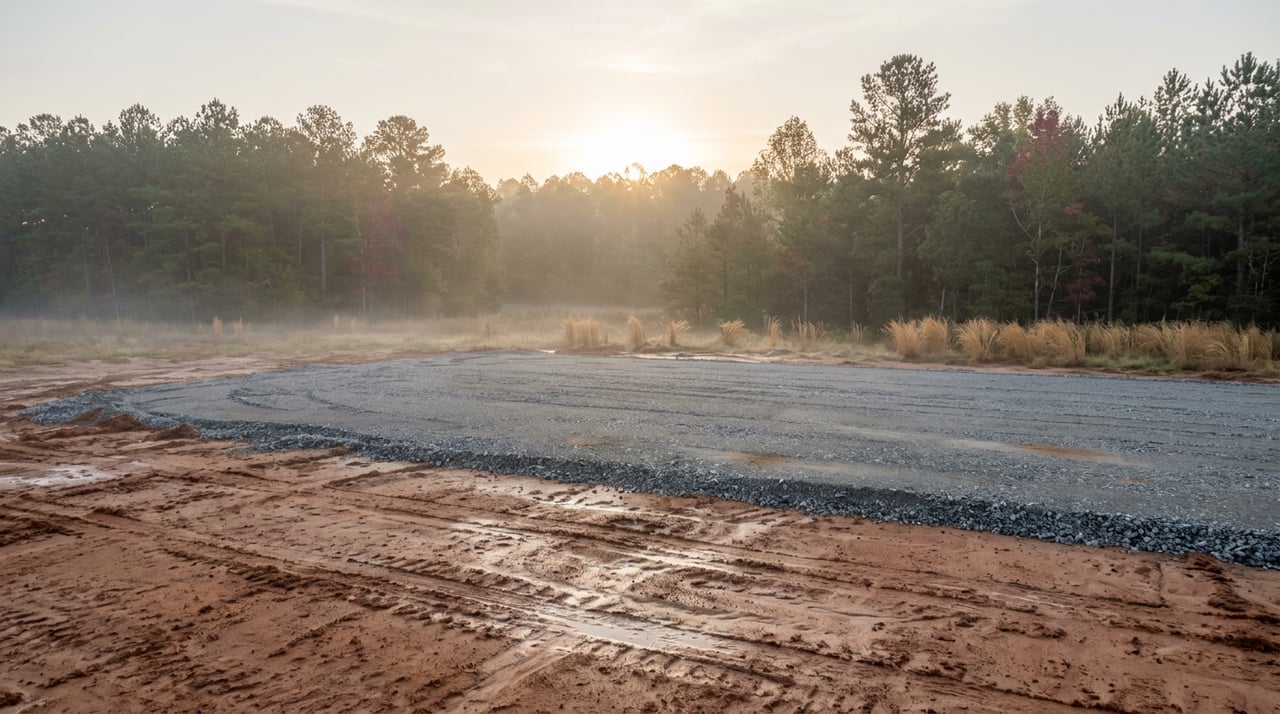
Malvern Just Spent $680,000 to Turn Dirt Into a Product. Here's What That Actually Buys.
Most of a Hot Spring County Quorum Court meeting runs on paperwork. Budget line clean ups. A transfer ordinance moving $25,000 to the sheriff's office so deputies can chase a state traffic grant. The kind of business that fills county minutes without anyone outside the room noticing.
Then County Judge Dennis Thornton stood up this past April and announced something that wasn't paperwork. The county had been awarded a $530,000 site development grant, and the court was matching it with $150,000 of its own labor and equipment, all of it earmarked for one thing: building more pads at the I-30 Industrial Park so the next company that wants to build here doesn't have to start from raw ground.
"It was a real home run for Hot Spring County," Thornton said of the award.
That sentence is worth sitting with, because it tells you something most acreage listings never do. The county isn't spending money to advertise this land. It's spending money to change what the land physically is, from a field beside the interstate into a site a business can build on this year instead of next.
If you're looking at commercial or industrial ground anywhere along this stretch of I-30, that distinction is the whole ballgame.
The $530,000 comes from the Arkansas Economic Development Commission's Site Development Program, part of a $25 million round distributed statewide to help communities get land ready for industrial tenants. Hot Spring County's match brings the total public investment in this specific push to roughly $680,000, and none of it goes toward a brochure or a booth at a trade show.
It goes toward pads. Grading. The infrastructure work that turns a rectangle on a plat map into a site a builder can permit and pour a foundation on within months rather than after a year of engineering and utility extension.
That's a different kind of value than most acreage listings communicate. A listing tells you lot size, road frontage, maybe zoning. It rarely tells you whether the ground underneath has already been prepared to receive a building, or whether that preparation is still years and hundreds of thousands of dollars away.
Here's the practical difference for a buyer sizing up two properties that look similar on paper:
| What public site-development money typically covers | What it doesn't cover |
|---|---|
| Grading and pad construction | Purchase price of the land itself |
| Utility extension to the site boundary | Marketing or signage |
| Engineering to make a parcel permit-ready | Private site work beyond the funded footprint |
Two parcels of the same acreage near the same exit can carry very different real costs to build on, depending on which side of that table they fall on. The one already benefiting from public site-development dollars gets you to groundbreaking faster. The one that hasn't gets you a lower sticker price and a longer, costlier runway before you can use it.
This isn't the only sign that Malvern's stretch of I-30 is getting long-term attention rather than a one-time grant. Arkansas's current statewide transportation improvement program lists a structures and approaches project at the I-30 and Highway 270 interchange in Malvern, meaning the interchange itself is in the state's funded project pipeline, not just a wish list item county officials are hoping gets picked up someday.
Combine that with the industrial park grant and you get a pattern rather than an isolated headline. The county is investing in the land. The state is investing in the interchange that serves it. Neither of those dollars shows up in a home price or a per-acre asking figure, but both of them shape what that acreage is actually worth to build on.
At the county's Economic Development Corporation meeting back in January, Chairman Rick McClure walked members through a site-selection presentation on the industrial park's progress. He pointed to adequate utilities, zoning compatibility, transportation access, and workforce availability as the traits giving the park a competitive edge over other sites in the region. Notice what's on that list. Not lot size. Not the sticker price of the ground. Readiness.
This is the part that catches people off guard when they start shopping industrial or commercial acreage along this corridor. The obvious assumption is that proximity to I-30 is what drives value, and it isn't wrong, exactly. It's just incomplete.
Highway frontage gets you visibility and access. It does not get you water, sewer, three-phase power, or a graded pad by itself. Two parcels can sit a quarter mile apart off the same exit, both with road frontage, and carry very different real costs depending on whether one of them has already had public or private money spent making it site-ready.
That's the reason the county is putting cash into pads instead of a sign. Readiness is the product they're selling to prospective employers, and it's the same thing a private buyer should be pricing when comparing two parcels that look identical from the road.
If you're evaluating land in this corridor, whether for a small business location, an investment hold, or a build-to-suit project, a few questions do more work than the asking price:
None of those questions show up on a listing sheet. All of them affect what you'll actually spend before you can use the land.
The same logic that applies to a 5-acre industrial pad applies, at a smaller scale, to commercial ground anywhere along Malvern's I-30 access points. We've watched this play out firsthand through our own work on Milestone Landing, a commercial project positioned along this same corridor. The parcels that move fastest and price highest aren't always the biggest or the most visible from the highway. They're the ones where a buyer can see, clearly, what it will cost to go from purchase to open for business.
Hot Spring County just put a number on that principle. $680,000 in combined public investment, aimed specifically at the gap between owning land and being able to build on it. That's not a marketing budget. It's an admission that raw acreage and site-ready acreage are two different products, priced differently, and worth understanding as such before you sign anything.
Does public site-development money ever come with strings attached for a private buyer? The grant funds public infrastructure inside the industrial park, not private parcels outside it. If you're looking at land near, but not inside, a publicly funded site, ask specifically whether your parcel benefits from the funded work or sits outside its boundary.
How would I find out if a specific parcel has already had grading or utility work done? Ask the seller directly for engineering or site plans, and confirm utility proximity with the relevant utility provider before you assume frontage means service is already at the property line.
Is the Highway 270 interchange project going to disrupt access during construction? Timelines for state transportation projects shift, so if access timing matters to your build schedule, that's a conversation worth having with ARDOT directly before you commit to a closing date.
If you're weighing land along this corridor, in the industrial park or nearby, Bluebird Real Estate spends as much time on the site-readiness question as the price per acre. Contact us before you make an offer, and we'll walk the specifics with you.

When we assist you with buying or selling, we evaluate the property and your goal as if they were our own. It’s really that simple – doing business the way it used to be done.
2905 Pine St PO Box 583 Arkadelphia, AR 71923