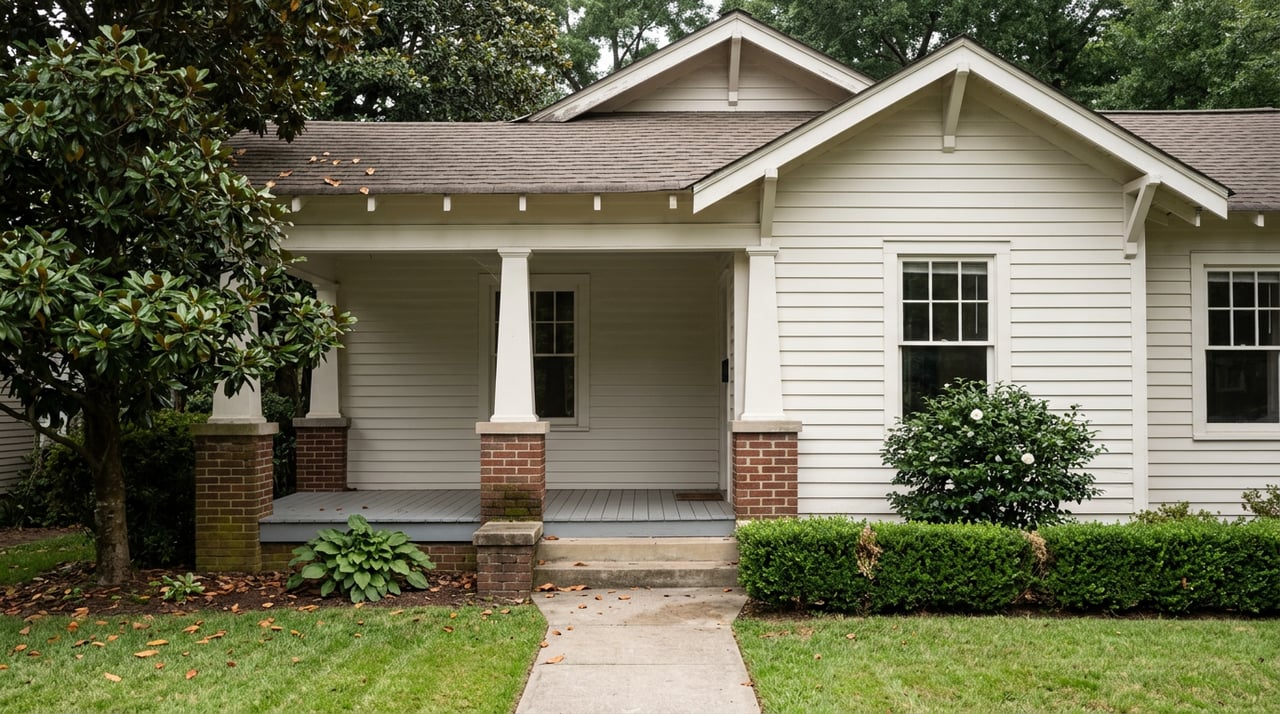
What an Arkansas Termite Letter Protects You From (and What It Doesn't) Before You Close on a Hillcrest Bungalow
"Let the buyer beware."
Three words that carry more legal weight in Arkansas real estate than almost anywhere else in the country, and they land hardest on the buyer standing in the crawlspace of a hundred-year-old bungalow in Hillcrest or the Heights, flashlight in hand, wondering what the seller's disclosure form actually promised them. The honest answer is not much. Arkansas leans on caveat emptor, the doctrine that puts the burden of discovery on the buyer rather than the seller, and its courts routinely enforce that doctrine in contract language. But there's one category of defect where the state does the opposite and locks down the process so tightly that almost nothing is left to chance. That category is termites. Everything else, in a house built before 1940, is left to you.
That split is the thing worth understanding before you write an offer on a Pulaski Heights-era home.
Walk into a closing on a Hillcrest bungalow and you'll sign two very different kinds of paper. One kind is the Arkansas Seller's Property Disclosure Form, a document your agent will hand you but that no Arkansas statute actually requires anyone to complete. It asks the seller to check "Yes," "No," "Don't Know," or "N/A" on questions about age, termites, and hazards like asbestos, radon, and toxic mold. A seller can check "Don't Know" honestly on almost every line and walk away from liability, because Arkansas courts generally won't compensate a buyer for a defect discovered after closing unless the seller actively prevented an inspection from finding it. That's caveat emptor in practice.
The other kind of paper is the termite letter, and it works nothing like the disclosure form. The Arkansas State Plant Board's Circular 6 requires that a termite clearance be bundled with a signed contract guaranteeing treatment for at least one year and a diagram showing the exact location of any past or present infestation. This isn't a checkbox. In much of the country, a pest inspector can sign a single page saying no termites were seen and call the job done. Arkansas won't let that happen. If evidence of past subterranean termite activity turns up anywhere in the crawlspace, the inspector is required to recommend treatment even when there's no active colony, and both VA and FHA loans require that treatment be completed before the loan closes. Conventional buyers usually build the same requirement into their contract as a contingency, because lenders and title companies expect the paperwork trail to exist.
So the state has built an unusually strict, almost bureaucratic system around one specific bug, and left nearly everything else about a century-old house to whoever thinks to ask.
The termite side of an Arkansas closing is genuinely protective, and it's worth knowing exactly what you're getting. The official form is the NPMA-33, the Wood Destroying Insect Infestation Inspection Report, and the Arkansas Department of Agriculture's Plant Industries Division oversees the pest control operators who issue it. When a clearance letter is written, state rules require three things to travel together: the inspection report itself, a signed one-year contract, and a structural graph marking any infestation history. If a licensed operator issues that clearance and termites show up within the guarantee period, the company is on the hook to treat the new infestation and repair the resulting damage, not just tell you about it after the fact.
That's a real safety net, and it exists because Arkansas sits in what pest control operators describe as a high-pressure zone for subterranean termites. The state decided the risk was significant enough to regulate tightly. It did not extend the same logic to knob-and-tube wiring or a settling foundation.
Here's the asymmetry that catches buyers off guard. A Hillcrest or Heights bungalow built before World War II almost certainly has legacy systems that predate any modern code, and none of them come with a state-mandated clearance letter. Home inspectors working these neighborhoods routinely describe finding knob-and-tube wiring concealed behind plaster walls, original cast iron plumbing approaching the end of its service life, single-pane windows, and foundation settling tied directly to Little Rock's red clay soil, which expands and contracts with moisture in a way that stresses old pier-and-beam foundations. Pulaski County also carries some of the highest radon readings in the state, and Arkansas itself is classified as a high-risk zone by the EPA, yet no law requires a seller to test for it or a buyer to request it. A radon screening typically runs about $100, and it's an add-on you have to ask for, not a box the transaction checks automatically.
None of this is illegal for a seller to leave off a disclosure form, provided they answer honestly. If a seller genuinely doesn't know their 1915 foundation has settled, marking "Don't Know" satisfies the law. The one hard exception is federal, not state: any home built before 1978 triggers a mandatory lead-based paint disclosure regardless of what the seller knows about anything else.
The practical result shows up in real negotiations. Inspectors working Hillcrest and the surrounding blocks have documented cases where knob-and-tube wiring found hidden behind walls in a 1920s bungalow led to roughly $8,000 in buyer credits, and a sewer line issue discovered near River Market saved a first-time buyer from an estimated $12,000 repair after closing. Those numbers didn't come from the disclosure form. They came from paying for a thorough inspection and using the findings at the table, which is exactly the leverage caveat emptor pushes onto the buyer's side of the transaction.
| What Arkansas locks down by law | What's left to your own inspection |
|---|---|
| Termite/WDI clearance bundled with a signed one-year treatment contract and infestation graph (Circular 6) | Knob-and-tube wiring hidden behind plaster |
| Lead-based paint disclosure for any home built before 1978 | Cast iron plumbing nearing end of life |
| Foundation settling from red clay soil movement | |
| Radon levels (elevated countywide, but untested unless requested) |
The reason so many Hillcrest and Heights homes carry these specific legacy systems traces back to how the neighborhood was built. The area now known as Hillcrest started as roughly 800 wooded acres bought by a group of Michigan investors in the 1890s, and it stayed sparsely populated until 1903, when a streetcar line was extended out from downtown Little Rock, turning the area into the streetcar suburb of Pulaski Heights. Construction accelerated through the 1910s, producing the bungalows, foursquares, and Colonial Revival houses that still define the district, including work by Charles L. Thompson, Little Rock's most prolific turn-of-the-century architect, and by George R. Mann, who also designed the Arkansas State Capitol. Pulaski Heights consolidated with Little Rock by a 1916 vote, folding the whole streetcar suburb into the city it's part of today.
Capitol View, just south of Hillcrest on a bluff overlooking the Arkansas River, followed a similar arc under developers including the Hillcrest Land Company and the Capitol View Land Company, and it remains almost entirely residential, with only a handful of duplexes and grocery storefronts mixed into more than 500 historic buildings. Across the river in North Little Rock, Argenta and Park Hill carry the same story on the same timeline, which is why an inspector working either side of the river describes the same list of legacy systems.
A house built in this window predates modern electrical code by decades. That's not a defect in the sense of something gone wrong. It's simply what a pre-code house is, and it's why an inspection on one of these properties has to be read on its own terms rather than measured against a house built last year.
If you're under contract on a bungalow in this corridor, a standard inspection plus the mandatory termite letter won't cover the categories the law leaves to you. Worth requesting up front:
Does Arkansas require a seller to fill out a disclosure form? No state statute mandates it, though real estate agents regulated by the Arkansas Real Estate Commission customarily provide the Seller's Property Disclosure Form as standard practice. A seller can still answer "Don't Know" in good faith on most questions and satisfy the law.
If the termite report shows past activity but nothing active, does that still matter? Yes. Arkansas rules direct inspectors to recommend treatment when they find evidence of past subterranean termite activity even without a live infestation, and VA and FHA loans require that treatment be completed before closing regardless of how old the damage is.
Can a cash buyer skip the WDI inspection entirely? A cash buyer technically can, since the requirement is largely lender-driven. Doing so also means walking away from the one-year pest company guarantee that comes bundled with a proper clearance letter, which is one of the few pieces of real, contractual protection built into an Arkansas closing.
If you're weighing a purchase or a sale in Hillcrest, the Heights, or Capitol View and want a clear read on what the disclosure form will and won't tell you, Bluebird Real Estate can walk you through the inspection and paperwork side before you're staring down a deadline. Contact us when you're ready to talk specifics.


When we assist you with buying or selling, we evaluate the property and your goal as if they were our own. It’s really that simple – doing business the way it used to be done.

2905 Pine St PO Box 583 Arkadelphia, AR 71923